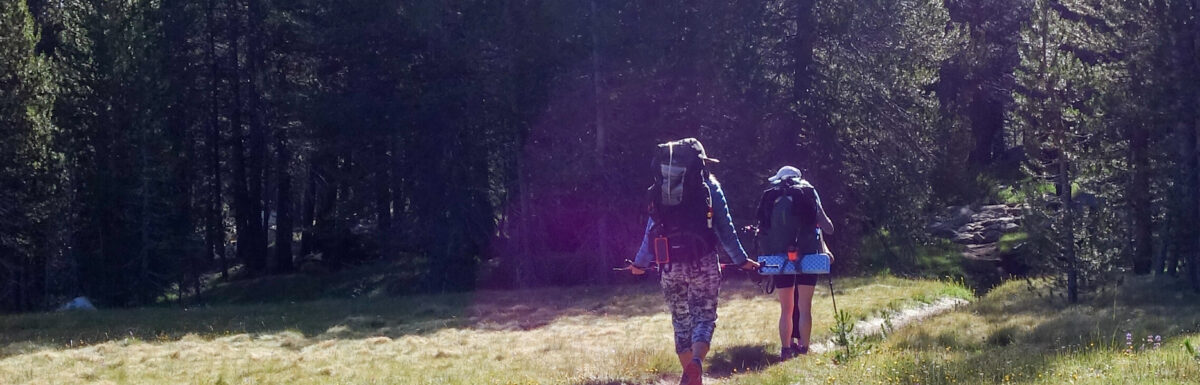
It is important that we enjoy our time in the backcountry, and physical conditioning is paramount.
We recommend starting to train as soon as you can to prepare for backpacking trips. It is much more fun getting to your destination each day when you your body is conditioned for your hike. Practice, physical conditioning, hydration and nutrition are all elements of a prepared hiker.
The more prepared you are the more empowered you’ll be! I’ve seen people who are not fitness buffs follow this plan and complete a rigorous backpacking trip successfully.
Suggested Training Schedule
Starting 3-6 months ahead of time, depending on your starting physical conditioning, age, and the frequency with which you will train, start regularly taking hikes that increase in duration and intensity. This is what we recommend for our backpacking hikes in Yosemite National Park that average 8 miles per day with elevation changes between 1500 and 3500 ft. per day. It typically takes 4-8 hours to arrive at our destination with plenty of breaks for epic vista appreciation, potty stops, catching breath on the uphills, lunch, and gear adjustment.
6 months out:
Take 1-2 hikes a week of a distance at least 75% of your goal. If your goal is 8-10 mile hikes with a 2000 ft. elevation gain/loss, plan training hikes of 6-7 miles where you climb/descend 1500 ft. AllTrails and The Hiking Project are great apps to locate trails near you and research elevation. Have fun on your hikes! Invite friends that you’d love to reconnect with or those that will attend your trip to help pass the time faster. Alternatively, I love to listen to podcasts, audiobooks, and music that really gets me pumped on training hikes. You’re investing a lot of time, so building your mental fortitude and knowledge base are value-add propositions to your investment. Bonus if you’re peak bagging! Core exercises, push-ups, squats, calf raises, and “core activation” are important to prevent injury as you train with more intensity. Tip: Look up core activation on YouTube – it’s different than crunches!
3-4 months out:
You should have selected and acquired some of your gear by now. Start taking your pack with actual equipment weighing approximately 20 lbs. including water and snacks.
Your training hikes should now be mirroring a typical day you expect during your planned trip in terms of distance, duration, and elevation gain. Duplicate your goal hike as much as possible 2-3 days a week if you’re intending on a hike longer than 3 days. Do calf raises while you’re in line at the grocery store, squats while you’re on conference calls, and core activation when you’re at stop lights and filling up your water bottle.
One expert I listened to on a podcast who has hiked literally THOUSANDS of miles was asked what distance he expected to cover on a particular route per day, and he explained that the distance isn’t as important as the elevation change you expect. If you don’t have hills near you get access to a stair master and train time with your pack going up AND down on it! People do it – I’m not making this up!
2 months out:
Add 5 lbs. to your pack and make sure you’re doing training hikes on back-to-back days. Increase your mileage to duplicate what you’ll experience on your trip. In addition to physical conditioning it will help you get acclimated to your gear, learn what is comfortable and what’s not, and help you figure out what adjustments to make so that you can hike longer distances without getting wiped out.
1 month out:
If possible go on a fully loaded real “shakedown hike” where you take the gear you’ll use on your trip for a spin. Try a dehydrated meal that you prepare with your ultralight stove/fuel, set up your tent, confirm that your sleeping bag is warm enough, make sure your shoes are comfortable, your pack is adjusted properly, etc. Use the gear you will actually use on your hike so that you know how to make it all fit before you’re in the middle of the wilderness and out of cell range for days.
1 week out:
Go on some conditioning maintenance hikes, but don’t over-exert yourself. If you have injuries let them heal. Make sure you drink plenty of water in the days leading up to your departure so that you don’t start out dehydrated. Mentally walk through your entire itinerary and envision yourself out there kicking butt! Stretch, hydrate, dream, and get excited! This is happening!
So what’s the secret? Invest in your trip with time, effort, and intent. Start early and start often!